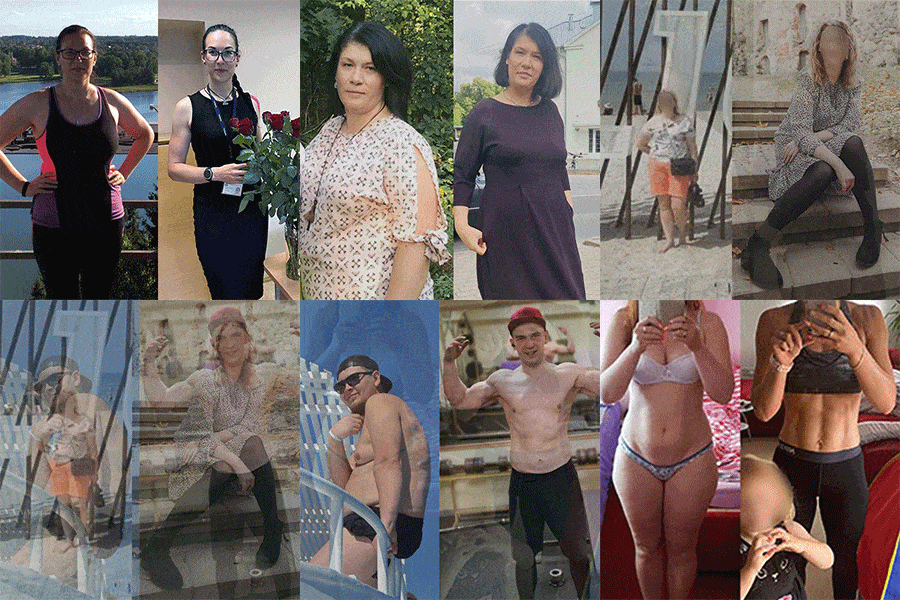
 EN
EN  LV
LV  RU
RU Peculiarities of Women's Training, or – Girls, Do Not Be Afraid of Barbells and Dumbbells!
- How do female physiology and hormonal cycles affect muscle growth, recovery, and strength training efficiency?
- Understand how resistance training improves women’s metabolism, body composition, and long-term health.
- Get science-backed tips to create an effective strength training plan tailored to female physiology and cycle phases.
Girls, just like boys, mostly don't know what, how, and why to do to achieve their dream body. That's why we rely on trainers much more often. It's beneficial if the trainer is truly a trainer, competent in all matters related to their field of activity. However, very often, especially in large fitness clubs, all beginners are given a completely standardised workout program, identical for both men and women.
Even in cases where girls rely solely on themselves and search for programs on the Internet, they often "fall for" programs that are completely unsuitable for them. That is why I am offering this article on the Differences in Women's Training.
So why do women not benefit from a classic men's training program? Let's start with the fact that although women's bodies are the same, they are... different. Everyone understands this, but I doubt anyone can name any specific differences, except for the appearance of the genitals and breasts.
Skeletal structure
Women have, on average, a skeleton 7% shorter and 8% narrower, as well as different proportions of body parts - women have much shorter legs and arms, but a longer torso and narrower shoulders, which means that this condition must also be observed during exercise and whether either the technique must be adjusted or an exercise must be abandoned. For women, because their center of gravity is lower, it is easier to perform exercises that require balance, but it is more difficult, for example, to run fast, jump, and so on.
Muscles
Although women have the same muscle structure as men and can develop just as much strength, women perform on average 40% worse in strength tests. That is due to anatomy – women are not naturally designed to have a large muscle mass (on average, it accounts for 35% of a woman's weight, compared to 45% for men). Men have larger skeletons, which means that their limbs form longer levers, allowing them to work more efficiently and lift heavier weights.
Women have more body fat, than men. This is purely due to genetic factors, as women have a different hormonal structure and fewer muscles that consume energy and are therefore more prone to subcutaneous fat accumulation (in general, women have a slower metabolism – each kilogram of a woman's body consumes less energy than each kilogram of a man's body). For comparison, if 16% subcutaneous fat is considered normal for a man aged 20 to 30 with no health problems (for an average man who is not overly active), then for a woman it is around 25%. Women's bodies are way more prone to storing fat than men's, because women are the ones who give birth, and therefore their bodies are naturally designed to store more energy so that when needed, there is enough energy for both the woman and her child.
Internal organs
Of course, if the body is smaller, then the internal organs are also smaller, and since they have to provide much less activity of the body, they also work at a lower intensity. For example, a woman's heart at rest is 10 cubic centimeters smaller than a man's. At the same time, at rest, the number of heartbeats per minute is higher for a woman, and so on. All this only means that women, in general, despite having specific cases, have much less functional training opportunities than men (on average 40% less).
As you can see, the differences are significant and quite a lot, but we have not yet come to the seemingly main and most visible condition influencing the training process, namely the menstrual cycle. Men can do their training program on the principle of "Take heavier, lift more" and work happily from month to month and even progress very well. For women, their physical condition and ability to work vary depending on the phase of the cycle.
In order not to get caught up in the very long description of the training theory, because in this case everything is determined by the individual menstrual cycle length, I can only add that in order to plan a proper training program, the classic scheme of a week is a microcycle. etc., which is relevant to men, is not suitable. When planning women's training, it should be assumed that the mesocycle is one menstrual cycle, but microcycles are each stage of the menstrual cycle - menstrual, postmenstrual, ovulatory, postovulatory and premenstrual. And if we are talking about really large-scale workouts, such as many / many usually imagine in the weight room, then they should be planned in the postmenstrual and post-ovulatory period, when the body receives about 80% of the total monthly load. The other three phases, each individually, carry out a workload of approximately 7% per month and are of a general nature.
Peculiarities of women's training
Now, in terms of the workout itself. What do girls usually do in the gym? No, I'm not talking about those who only torture themselves with cardio machines, but about those who at least understand what and how to do it. Legs, buttocks, press, in some cases shoulders and arms are trained, but in order to talk about a proportionate and healthy body, the whole body (individual muscle hypertrophy and increased tone, with weak other muscles does not promote health).
When it comes to the whole body, it is important to understand that women, who have lower levels of muscle-building hormones than men, do not benefit from extreme splits. At least in the beginning, it is absolutely necessary to train according to the "full body" principle. Later, when your overall fitness level has improved, you can switch to an upper/lower body or pull/push system, which is a variation of the full body program, divided either by target group or target movement. In any case, girls shouldn't focus on training one or two muscle groups in a single workout using many isolation exercises.
It should also be noted that, precisely because of all the peculiarities of the body mentioned at the beginning of the article, it makes no sense to work with women with heavy weights and few repetitions (it already makes sense to solve specific tasks), because studies show that the body responds best to stress ( aiming for muscle hypertrophy) with 12-15 reps, ie twice as much as usual during periods of heavy training (6-8 reps). This is due to the fact that women have less muscle fiber, as well as the fact that the body is much better able to accumulate glycogen in the muscles. That's why training should be LARGE. Yes, yes, not the way many think that girls should train less, but vice versa. Often the total amount of work a lady does in training exceeds the workload of the average male.
Some might shout: "Hello, pink dumbbells!", thinking that when working out in this way, the weights will be very light. This may be true at first, but just like men, women also need to track their load/weight progression and follow the same rule that 12-15 reps should be the maximum they can perform. However, there is another difference – due to hormonal differences, women cannot train "to failure" (if they do not use artificial hormones); they are unable to do so, because they will stop a few repetitions before the theoretically possible maximum number of repetitions. BUT she doesn't need to either.
Here, too, I would very much like to say a few words about 'scrambling', which many women cite as one of the reasons why they do not go to the gym or work in the gym under some incomprehensible system.
As mentioned above, a woman's body is not physiologically designed for significant muscle growth - low testosterone, less muscle fiber, and so on. It should also be understood that women usually come to the grass to make their figure more expressive, which usually means slimming. Slimming, on the other hand, means limiting the amount of calories consumed to a certain deficit. To grow muscle, you need extra calories because you need to provide your body with energy and extra energy to build muscle. When there is a lack of calories, even serious male athletes who use pharmacology, subordinate their entire daily rhythm to training and getting in shape, etc., do not get to grow muscles, so a girl who goes to the gym three times a week is NOT threatened.
If someone immediately puts out the bodybuilders of the IFBB PRO league, then I can reassure you - if you do not intend to dedicate your whole life to getting this shape, then nothing will happen to you, even if you want to, because they are exceptions. Women have been training for decades, using pharmacological means, as they say, for buckets, adjusting their lifestyle to a few cm of muscle growth, and so on. It can only be tolerated / achieved even with great desire, it cannot be done ACCIDENTALLY.
I can remember countless cases where girls say they don't want to be bodybuilders but want to do fitness. By and large, fitness, if we look at it as an approach to training, the same bodybuilding alone is, only the end result is not so serious, ie bodybuilding is the highest level of fitness and exists ONLY at a professional level. Everything else is fitness.
It is to be understood that it is the muscles that make up most of the body's shape and 'roundness' (excluding the breasts, as they form fat). If a girl wants to change her figure, she has to build muscle or reduce the amount of subcutaneous fat to highlight the existing muscles.
That is also all I wanted to say in this article. The main idea that should remain with the readers after reading this article is that women should not be afraid of weight loss medicine, they just need to train PROPERLY and the results will not be missed.
Share this article
Follow me on Facebook
I recommend reading these articles as well

How to relieve muscle soreness after a workout?
What causes muscle soreness after exercise and how can we relieve it?

The best slimming program
Which is better - fast or gradual weight loss? How to maintain your reduced weight? What is the best weight loss program?
How To Develop Muscle Strength And Endurance
Have you been to the gym for a while but can't see the results? You may not challenge yourself enough.

Why can't I lose weight?
How to lose weight and the top 12 reasons you lose less weight than expected.